POST NUMBER 7
In early 1985 I was invited by the UK engraver and knife dealer Simon Lytton to meet Howard Hitchmough at his home in Fox Hill, London. Howard would go on to become the best stock removal knife maker the UK has produced in the last 50 years.
When I visited Howard’s flat the famous UK collector Dr John Anthony was also there. John had been the coach of the British Olympic shooting team and was a well known figure in competition shooting in the UK. However John’s real passion was custom knives and he owned some of the very best available anywhere at the time. John invited me to his home and for the first time in my life I saw knives from the iconic makers I had only dreamed about.
John had Loveless’s, Johnson’s, Lake’s, Horn’s and just so many more. I had a chance at a very young age to not only see these knives at my leisure but also have John and Howard Hitchmough explain why they where so good and what to look for in a custom knife. This experience was invaluable to me.
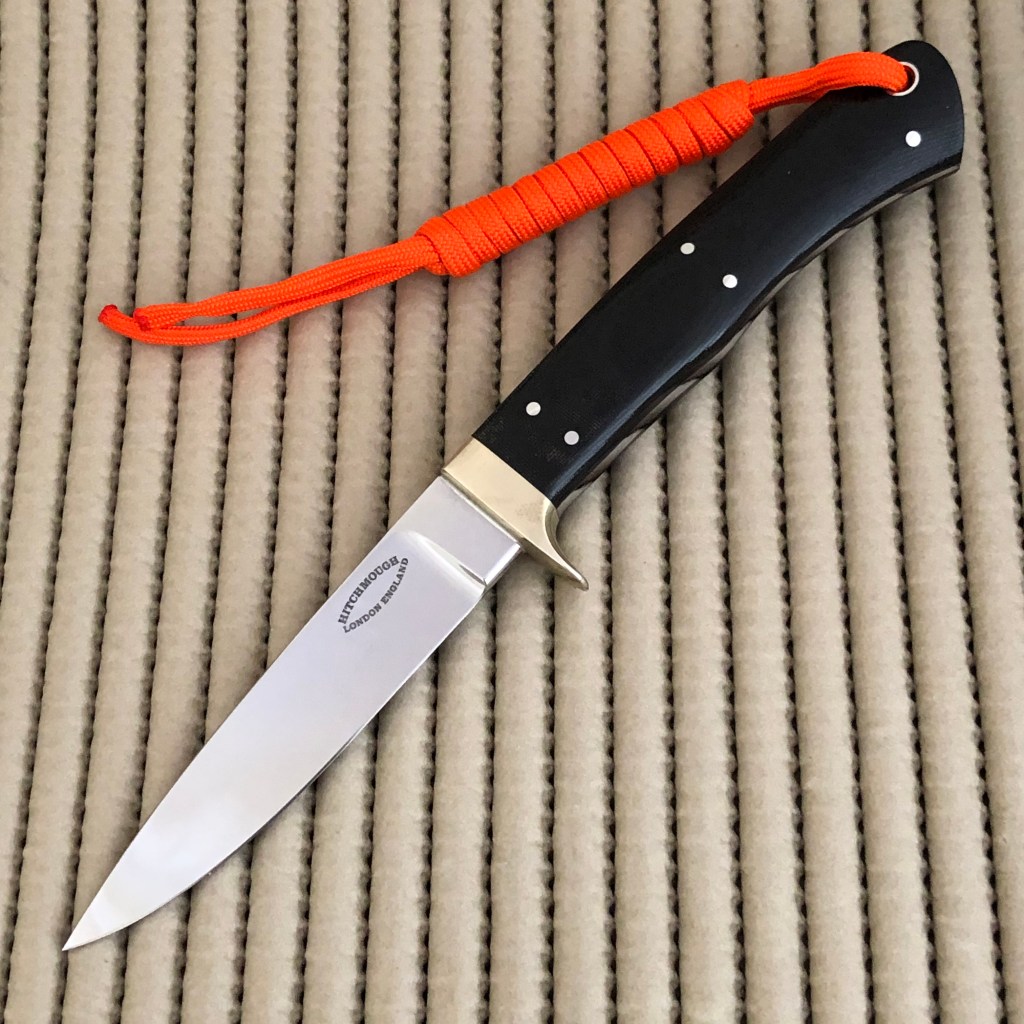
That first night at Howard’s flat I purchased my first of many knives from him, a small drop point hunter with black Micarta scales in D2. Little did I know it would be a relationship and friendship that would last over 35 years until he retired.
That night I also ordered my first pair of fighters from him, a large and small Loveless style sub-hilt with Ivory scales. These were also made from D2. I later had this pair engraved by Jon Robyn.
This meeting really changed my whole appreciation of custom knives. Before this my personal experience was really centred around South African makers and their work of the time which was very fixed blade and hunting orientated. For the first time in my life I had a chance to see, handle and experience the really top stuff.
I urge any new collector or maker to try and seek out a collector who can show them things that they would otherwise never have the opportunity of seeing. By examining and experiencing the best out there you have a chance to see what the top standards are. I try and do this for new collectors and makers by displaying some of my knives every year at the Cape Knifemakers Guild. It gives people a chance to see and experience knives they would otherwise never have a chance to see.
The first knife I ever purchased from Howard Hitchmough.
POST NUMBER 6
I am often asked “what is the value of this knife?”
As a collector it can often be a very difficult question to answer. Over the years one gets a feeling of rarity and appropriate value that accompanies certain knives but I do get it wrong sometimes.
I have overvalued things which I thought should sell fast but never did, and I have undervalued things which literally jumped off the table. It is always best to do your homework and check as many sources and sites as possible. However to the laymen there can be pitfalls.
Some years ago I was contacted by a family who had inherited a custom knife collection. I was familiar with almost all of the makers in this collection and I owned pieces from most of the makers so I had a pretty good idea of the values. They e-mailed me a list and I put my provisional values on the knives sight unseen based on their description of the knives being perfect. When the family replied to me they were not happy with my valuation. They said that they had seen knives made by these makers sell for higher values than I had assigned to their knives. I explained that not all models were as desirable as others and handle material and the things played a part in my valuation. A few weeks later I saw the collection in person. I was shocked. The knives had been stored in a cardboard box in a damp basement near the sea. Most of them still in their sheath’s. All the knives had significant rusting and marks on them. Some even had mould on the handles. I informed the family that as far I was concerned the knives were worthless……….needless to say they were very upset with me.
I explained that the condition of the knives meant everything but alas they were having none of it. They immediately went in search of another valuation and were promptly told the same thing. Eventually some shady pawnbroker took them on a sale or return basis and that was the last I heard of them. A whole collection ruined.
The moral of the story is that knives need to be cared for. They need to be cleaned and oiled regularly and generally maintained so as to maintain their value. Failure to do so results in a total loss. No matter how famous the makers name is on the blade, if you don’t keep it in good condition (pristine is better) the value plummets. The value of your collection is directly related to the care and maintenance that has been bestowed on the knives.
POST NUMBER 5
It has been my great pleasure in the last few months to spend some time with some of our biggest collectors of knives here in SA. One of the things that has immediately struck me in my conversations with other collectors is the similar experiences many of us have had with knife makers over the years who insist on being paid upfront for unbuilt knives.
Almost all the collectors I know have had the experience of ordering knives, paying upfront and then having to fight and nag the makers to get their knives. All the while the maker continues to produce work for shows and Instagram sales, but the customer who paid upfront struggles to get his knives.
Folks, as far as I am concerned paying for a knife upfront is foolhardy. Don’t do it.
One of our best knife makers in SA and a personal friend often says to me……
“The hardest knife to make is one that you have already been payed for.” he is 100% correct.
That is why he NEVER takes funds upfront. I urge all collectors never to pay upfront, and if the knife maker insists on it, run a mile.
By all means a knife maker can ask for a small deposit to secure the order ($25-$50). They can ask for payment upfront to purchase unique materials like Damascus steel, gold or Mastodon ivory. But the major part of the payment should take place when the knife is complete and ready to ship.
The system I favour for knife makers is that of a build list rather than a order book. This is the system Tony Bose uses. Essentially the customers name gets placed on a build list and when the maker is a few weeks from starting your knife, he contacts you, confirms you still want it (and you can afford it) and then you decide on exactly what the knife is and the cost. The system works excellently and removes a lot of problems and embarrassments.
POST NUMBER 4
I am often asked about Stag as a suitable handle material. I am lucky enough to own some beautiful Stag handled knives many of which were purchased many years ago. At that time Sambar Stag was plentiful and of a very high quality. Currently it is very hard to find good Stag. Most of the good pieces that are available are either too small for larger fixed blade knives, or have the incorrect shape.
While good Stag can make a plain knife extraordinary, bad Stag can ruin even the best of blades. My advice is not to order Stag on a knife unless you have seen the scales beforehand with your own eyes.
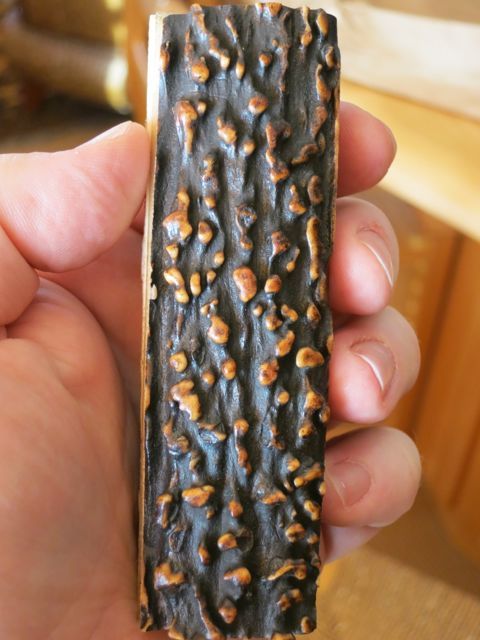
A matched set of exhibition grade Stag handle scales. Stag like this is increasingly hard to find…..
Some years ago I ordered a folder from a very famous U.S. maker and I asked him if I could provide the Stag for the handle scales. He refused and insisted on providing the scales himself. The following year when I arrived to collect the knife, even before he had shown it to me, he sheepishly said that I was going to be disappointed……. I was. The Stag scales were awful and ruined an otherwise good knife. I refused to take it and he agreed to make me another with Stag I provided. The new knife turned out to be one of the nicest folders he ever made and he could have sold it a dozen times over. It was a good lesson. Folks will pay a premium for exhibition grade material but fitting cheap, ugly scales on a knife just to say that it’s Stag is a fools errand.
My advice is to be very careful when ordering a large knife with Stag as it is almost impossible to find good flat pieces with a nice popcorn finish today. Far better to stick to a nice wood and know what your final piece will look like.
This beautiful Howard Hitchmough Lock Back Folder with some of the best Stag you will ever see on a knife. The scales are flat, even, and well figured. Stag like this is very hard to find today.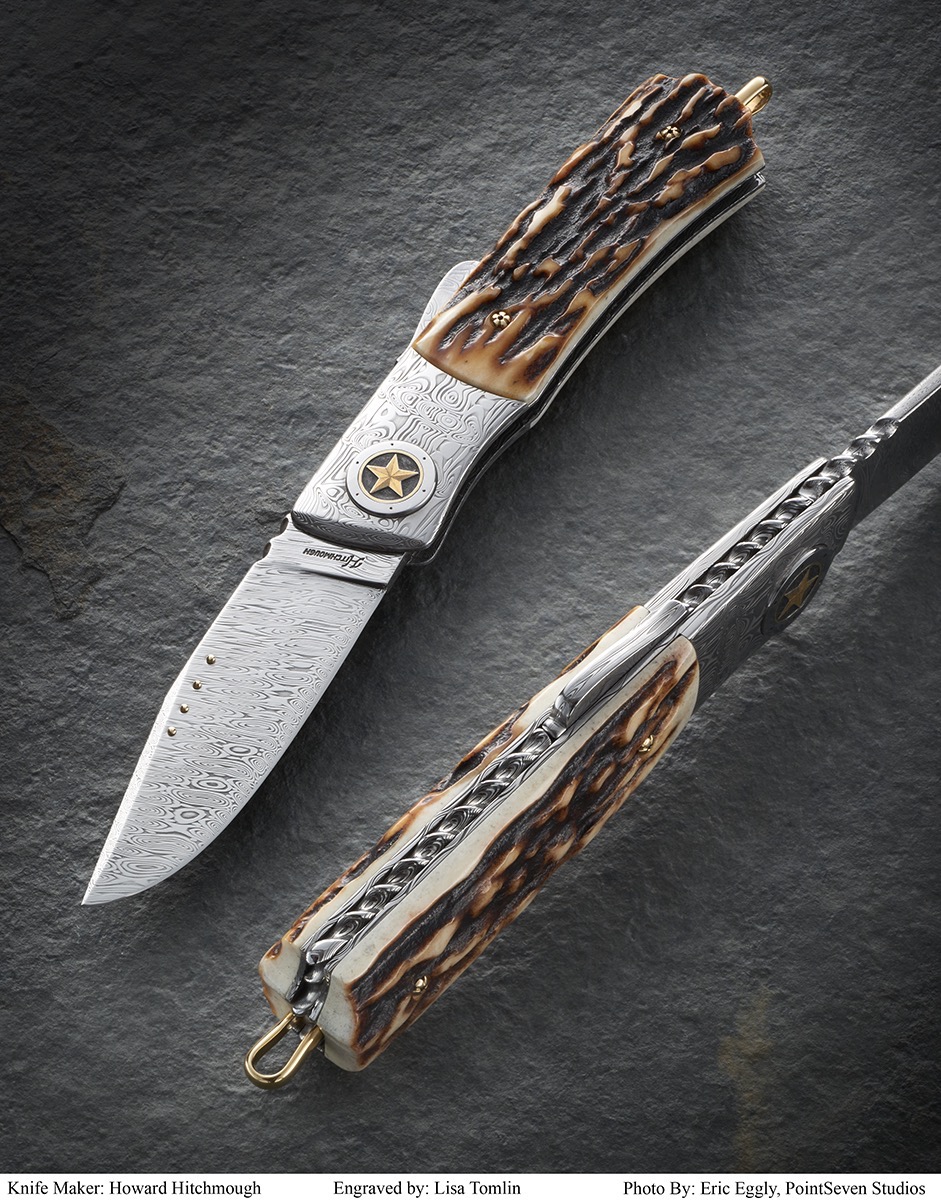
POST NUMBER 3
It seems strange now to think that once upon a time Balisongs were legal everywhere but back in 1986 they were. That year Chris Reeve and I attended the New York Custom Knife Show at the Roosevelt Hotel in Manhattan. (Today it would be impossible to have that show in Manhattan due to NYC’s onerous knife laws.) It was the first show in the U.S. Chris had ever attended and he had a table to sell his One Piece Knives (OPK’s) and custom knives. I was there to meet the guys from Pacific Cutlery Corp (PCC), the makers of the best Balisongs in the world. I had begun importing and distributing PCC knives earlier that year to compliment my Chris Reeve selection and I wanted to meet them in person to talk to them about distribution.
The New York Custom Knife Show was a revelation. It was the first U.S. custom knife show I had attended and it was heaven. In those days there were two major shows in the U.S. every year, the NYCKS and the U.S. Knifemakers Guild Show which at that time was being held in Dallas, Texas. (There were other significant shows like Solvang and the L.A. knife show but they were much smaller.) Anyone who was anyone was there. Ron Lake, Jess Horn, Michael Walker and so many other iconic makers to numerous to name. Ironically Chris Reeve had two of the very best custom knives he ever made at that show for sale. A beautiful all titanium dagger with ivory inlay and a magnificent Russian style Kindjal with a Damascus blade and an ivory handle. Neither sold. In fact Chris sold nothing at his first New York show but he saw and purchased an early Michael Walker liner lock which was to be a historical purchase. That Michael Walker led Chris to design the frame lock and change folder design forever.
I purchased several knives for my stock at that show including this really plain basic hunter from a new knife maker named David Broadwell. I also purchased a number of custom Balisongs from PCC which I sold to collectors very quickly. Almost all of these were ground by Jody Samson and today they would be worth real money.
One of the things I most regret the most about that time was the fact that my knowledge and taste was so basic. Had I known more and understood more I would have invested in a Ron Lake, Steve Johnson and a Loveless or two. Today the price of these knives is just so prohibitive. I remember that Ron Lake had a beautiful stag tail lock at that show for $995-00. I think its important to remember just how much money that was back then. It was more than my entire trip to the U.S. cost, but how I wish I could go back in time!
The David Broadwell I purchased at my first NYCKS in 1986.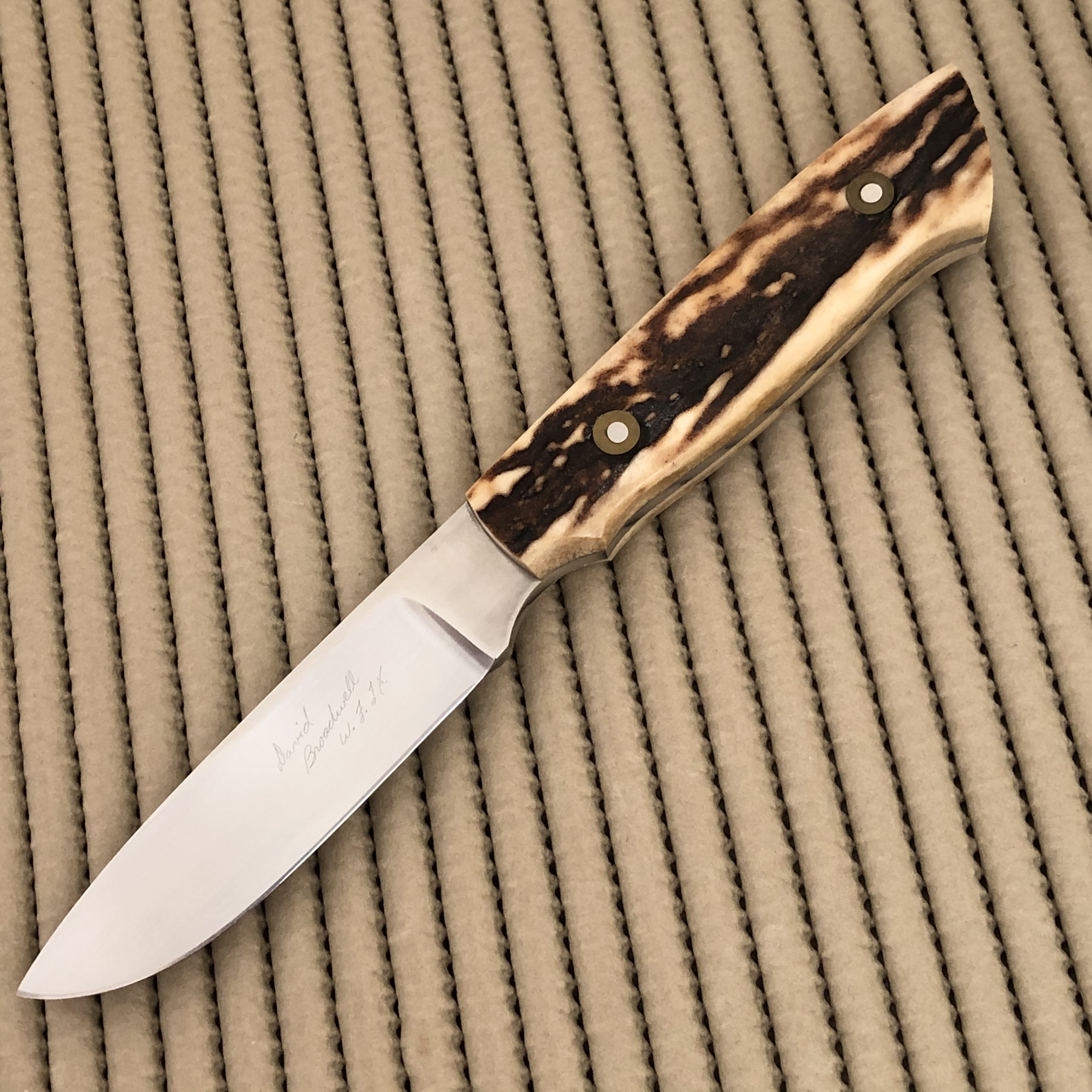
POST NUMBER 2
I want to have a quick chat about the importance of cataloguing your collection. It is really important to try and keep good records about your knives. Years pass and you forget when and where you acquired a piece. I save all the paperwork I receive with a knife, scanning it into my computer and ultimately adding it to my personal catalogue of each piece.
I use an online app called CatalogIt https://catalogit.app It is cloud based and can be used and accessed from multiple devices. It has the facility to create a mini webpage about each item allowing you to upload multiple images and scanned documents. The first 100 entries are free but after that you pay a monthly fee.
For estate and insurance reasons cataloging your collection is critical. I try and maintain an updated value for each item so that in the event my family are left with the collection, they have some idea of the value. I also use a unique ID number to to ta each knife so I can easily access the correct knife without having to unwrap the incorrect pieces. I also tag the corresponding sheaths with this number. You have no idea what a pain it can be years down the line to try and match sheaths with knives.
One of the other great things I love about the app is that it allows you to capture information at the exact time of purchase using your phone. Always a huge help at a show.
POST NUMBER 1
Greetings and welcome to my knife blog.
I have been collecting custom knives for almost 40 years now. I am not really certain where and when my love for blades began but it started at a very young age.
As a boy growing up in Durban, South Africa. In the 1970’s custom knives did not really exist in my world. Occasionally my mother would take me to a famous sporting goods store in Durban called Kings Sports (I ended up working there many years later). I would sneak across to the gun department and peek into the display cabinets full of Puma, Victorinox and Gerber knives.
In those days the ultimate Puma to own was a White Hunter. Kings also sold Gerber knives and I remember thinking that the MkI and MKII were the most beautiful things I had ever seen. Other boys wanted to play cricket and rugby, I just wanted to have a good knife in my hand!
The only publication that occasionally featured knives in hose days was our local gun and hunting magazine, Man Magnum. Between articles about square bridge Mausers and Colt Pythons I could sometimes find an article or two about knives matched with a few precious pictures.
It was the early days of what was to become the Knifemakers Guild of South Africa (KGSA) Often the pictures in the magazines showed some of our early and most influential knifemakers like Piet Grey.
In the summer of 1978 my folks moved to Atlanta Georgia in the southern United States and all of a sudden I found myself away from home in a strange environment without friends.
I became engrossed in reading and soon I discovered the local public library (much to my parents relief) Amazingly the library had a section on firearms and hunting and I discovered a book that would change my life forever and start me down a road that I follow to this day……….It was called Knives and Knifemakers by Sid Latham. To this day a copy resides next to my bed.
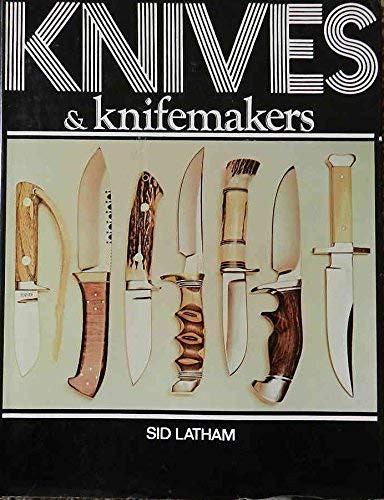
I checked the book out and every few weeks or so returned it back to the library and checked it out again. I was in love with the contents, pictures and particularly the knives.
It was always hard to find information about knives and most of mine came from the pages of Guns and Ammo magazine. My Mum took me at the ripe old age of 14 to buy my first knife. A Puma clip point lock back folder. It went everywhere with me.
At a later time I was also able to add a Gerber Guardian to my small but growing collection and several factory small slip joint and lock back folding knives. However it soon became obvious to me that my first love was fixed blade knives and particularly military and fighting knives.
I returned to South Africa and in the early 1980’s I found myself living in Johannesburg. By this time I already had a nice collection of factory knives including a Kershaw Trooper, Kershaw Agent and a Kershaw 1050 Folding Hunter. These were some of the most iconic knives Kershaw ever made and I am lucky enough to still have them to this day. They were all purchased from a famous knife shop in Johannesburg that still exists today called the Sharp Edge. Although the store that I bought them from in the Carlton Centre in the Johannesburg CBD no longer exists.
I heard about a custom knife show being held in Johannesburg not far from where I lived and I attended that show. There I met Chris Reeve who was later to become world famous as the owner of CRK (Chris Reeve Knives).
It turned out that Chris and his then girlfriend Anne were from Durban and lived only a few miles from where I grew up. A few months later I moved back to Durban, began a job at Kings Sports Gun Department and I visited Chris to see his knives. I immediately ordered two knives not knowing how I was going to pay for them but I found the money. When the first one was ready I went around to Chris’s apartment and we went for dinner to celebrate.
The first knife I purchased from Chris Reeve. A custom hunter in Tambootie with matching wooden sheath.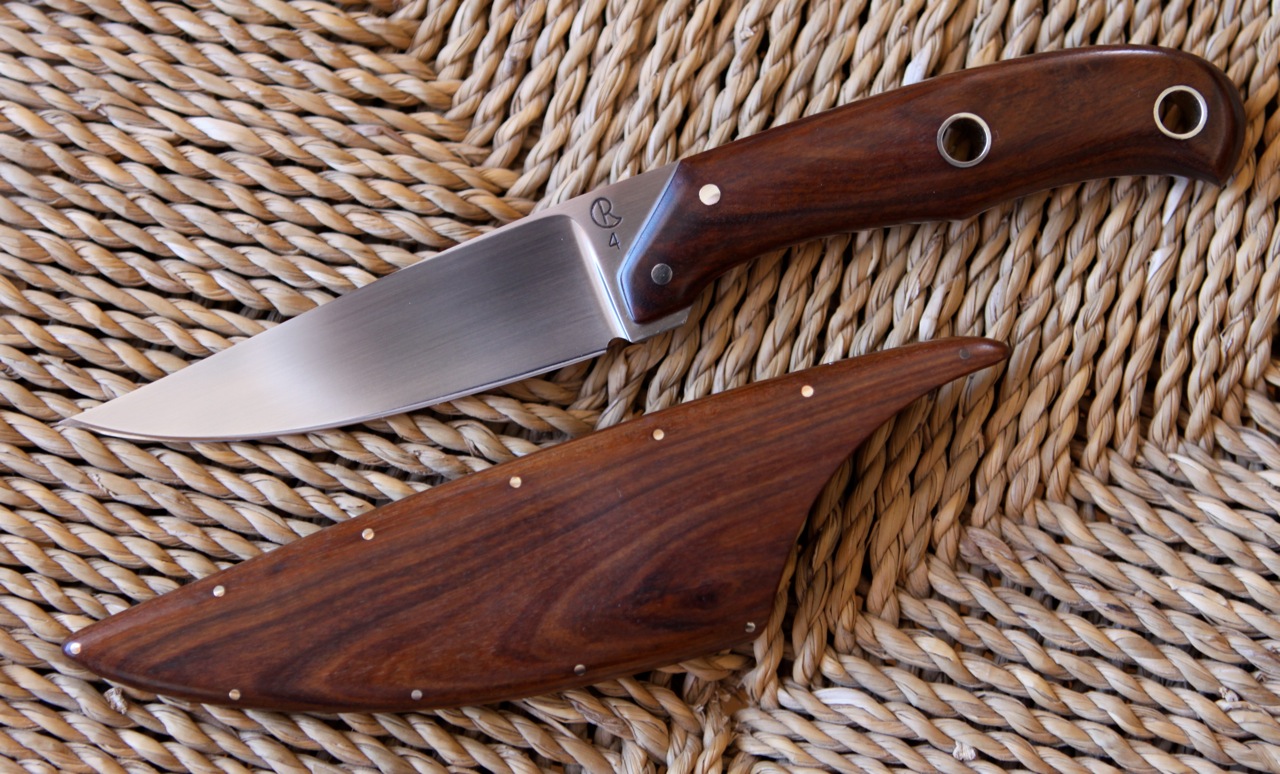
Chris introduced me to another iconic South African knife maker named Andrew Frankland. He lived in Warner Beach just north of Durban and I began ordering and buying knives from him. Here are two of his knives………….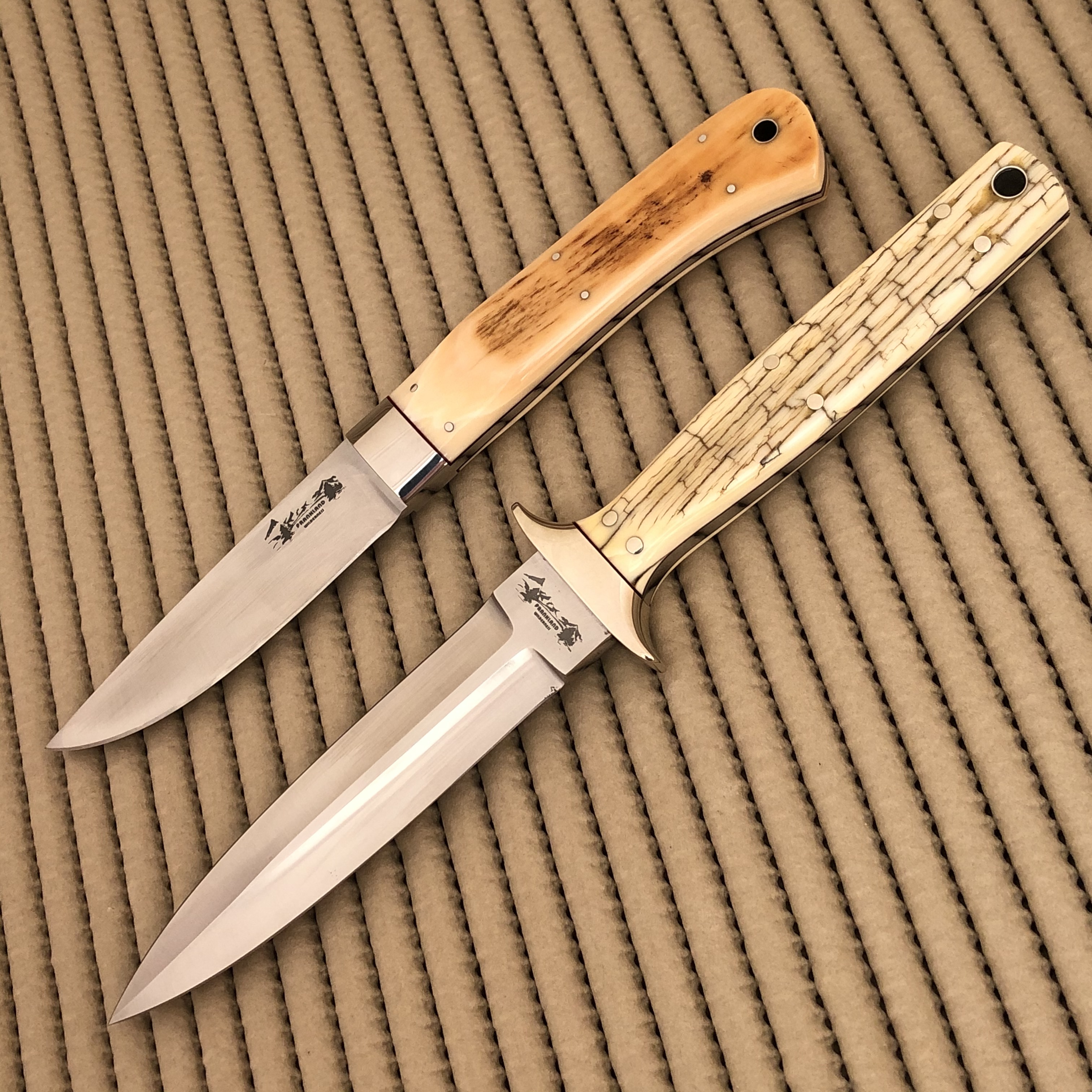
It was very early days in the South African custom knife world and Durban had an annual knife show attended by all the top knifemakers. For me that show was Nirvana and I looked forward to it every year.
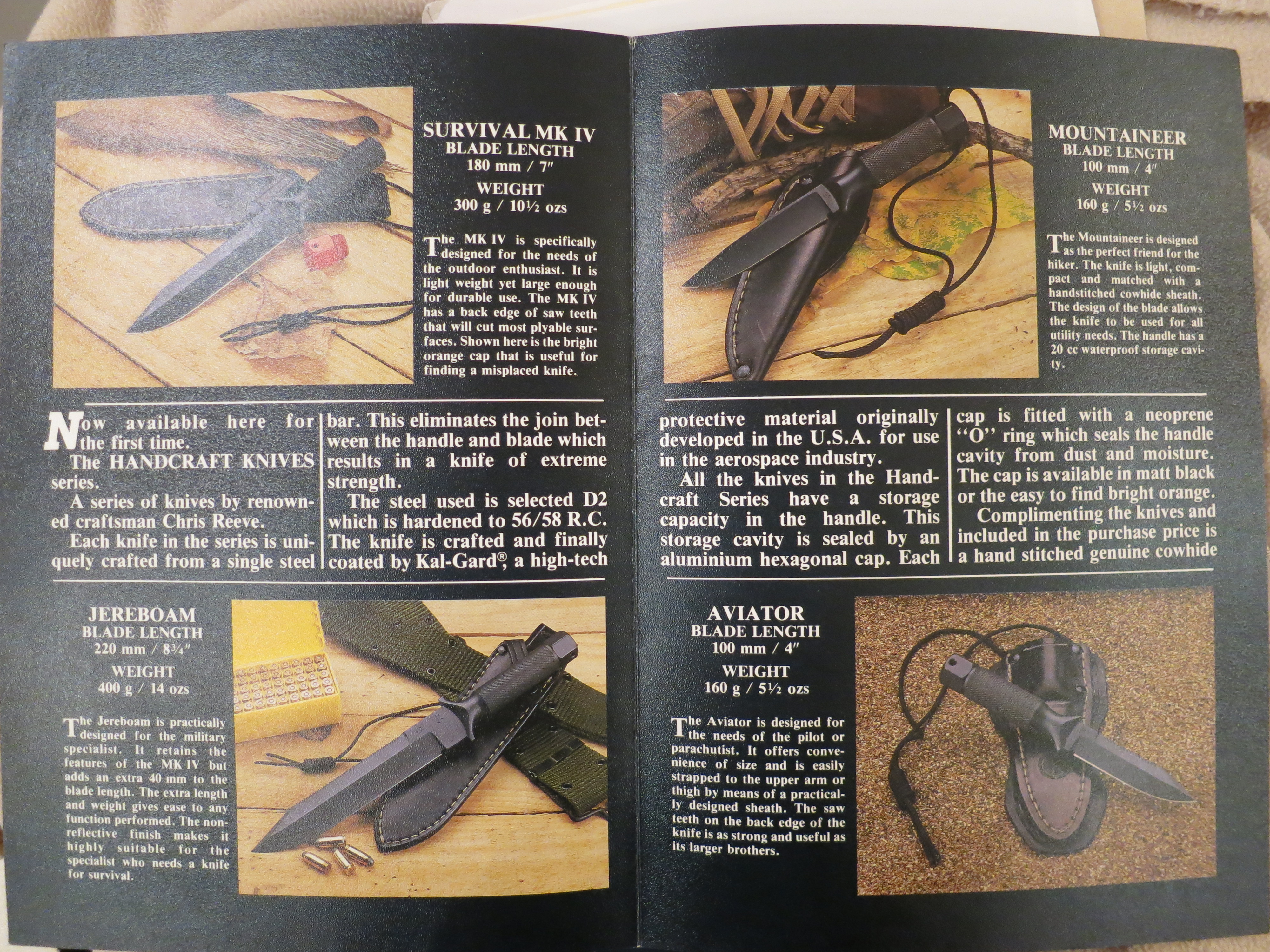
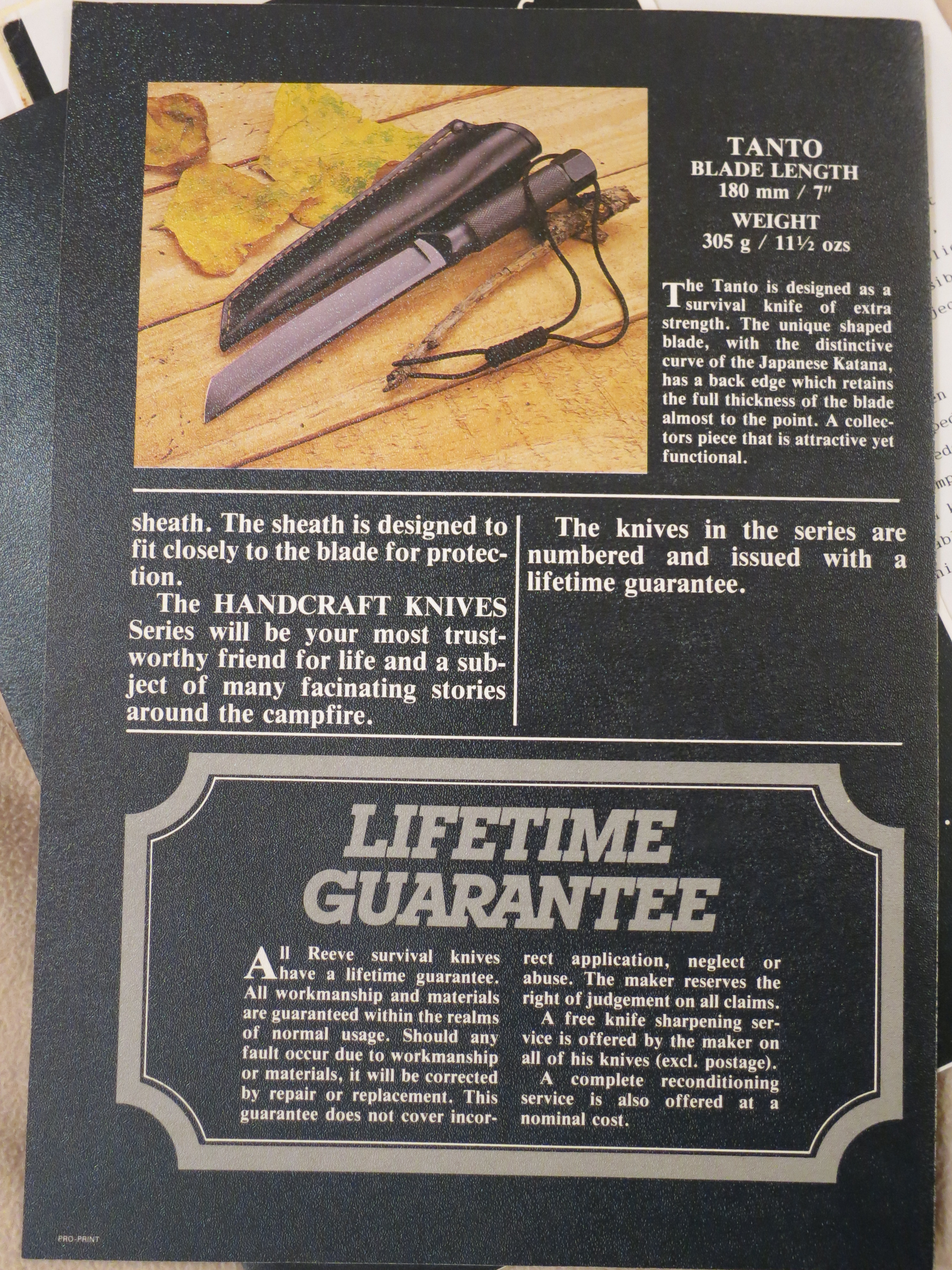
In 1985 Chris had just released his One Piece knife series with five models. The Jereboam, MkIV, Tanto, Aviator and Mountaineer. I asked Chris if I could sell knives for him. He agreed and I immediately made my plans. I called my company Handcraft Knives.
I set about making a full colour four page brochure. I had all five models professionally photographed and I wrote the copy for the brochure myself. We printed them in Durban, I was in the knife business!


 Steven's Blog